



















The Quantum Decarbonization Roadmap
Explore sectionsAbout
Policy Frameworks for Net-Zero in the Age of AI
Overview
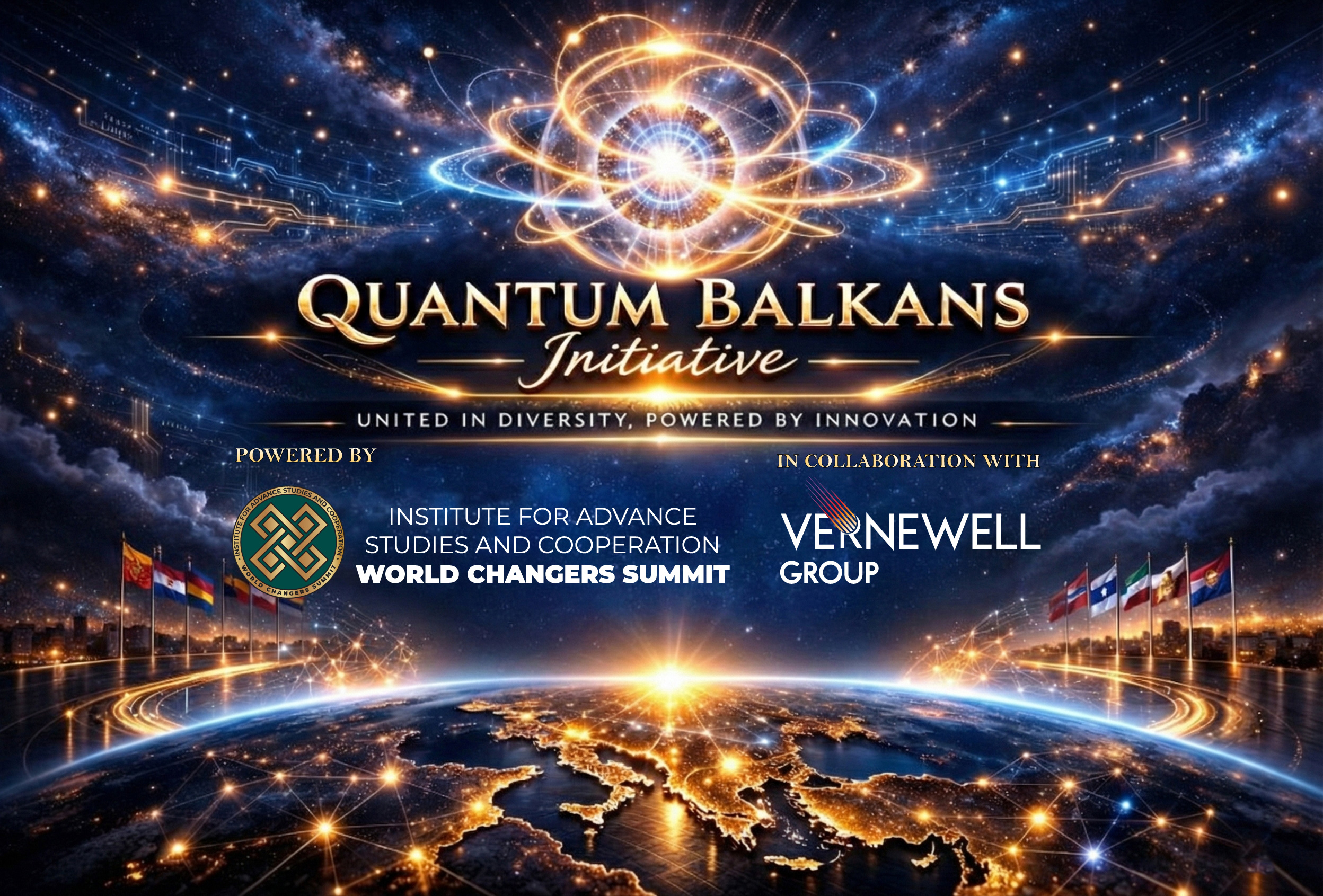
The Quantum Decarbonization Roadmap: Policy Frameworks for Net-Zero in the Age of AI is a strategic initiative promoted and seed-funded by the Institute for Advanced Studies and Cooperation (IASC), under the guidance of Manuel Rocamora, IASC Special Advisor for Innovation.
Its purpose is to explore how the convergence of quantum technologies and artificial intelligence (AI) can support the global transition towards net-zero emissions, providing governments, regulators and industry with concrete tools for action.
Rather than treating quantum as a purely technical frontier, the Roadmap approaches it as a policy, ethical and strategic challenge: How can quantum and AI be directed towards the common good, the protection of the planet, and a just energy transition?
⸻
Why Quantum & Net-Zero?
The transition to net-zero requires dealing with problems of extreme complexity:• integrating high shares of renewable energy in power grids;• optimising industrial processes in hard-to-abate sectors such as steel, cement and chemicals;• designing new materials for batteries, catalysts and CO₂ capture;• modelling climate risks and systemic vulnerabilities in global infrastructures.
Quantum technologies, especially when combined with advanced AI, are expected over time to offer new capabilities in:• simulation of complex physical and chemical systems;• high-dimensional optimisation;• secure communication and quantum-safe infrastructure.
The Roadmap does not promise a “magic machine” that will solve climate change. Instead, it aims to clarify where, how and under which conditions quantum and AI can meaningfully support decarbonisation – and where expectations must remain prudent.
⸻
Vision
Our vision is to:
Build a global, ethically grounded framework that connects quantum and AI innovation with concrete pathways to net-zero, ensuring that these powerful technologies serve people, the planet and peace.
This means:• treating quantum & AI as public-interest infrastructures, not only as commercial or military assets;• aligning technological development with climate goals, social justice and human dignity;• creating spaces where scientists, policymakers, industry, faith-based and civil society actors can think together.
⸻
Objectives
The Quantum Decarbonization Roadmap pursues five main objectives:1. Map policies and regulationsAnalyse existing frameworks on quantum, AI and decarbonisation in key regions (EU, Gulf, North America, Africa, emerging economies), identifying gaps, risks and opportunities.2. Develop a “Quantum Decarbonization Policy Toolkit”Provide governments and regulators with practical guidance: options, standards, best practices and decision-support tools for using quantum & AI in support of net-zero.3. Design strategic pilot use casesCo-create pilot projects in sectors such as:• power systems and smart grids,• hard-to-abate industrial clusters,• CO₂ capture, utilisation and storage (CCUS),• circular carbon economy.4. Integrate ethics, security and inclusionAddress the ethical, social and security implications of quantum & AI for climate: quantum-safe infrastructure, cyber-physical resilience, equity of access, impact on vulnerable countries and communities.5. Foster international dialogue and cooperationBuild bridges between Europe, the Mediterranean, the Gulf and other regions, positioning IASC as a scientific-diplomatic hub that connects institutions, academia, industry and faith-inspired actors.
⸻
Thematic Pillars
The project is organised around five thematic pillars:1. Quantum & AI for Climate Modelling and RiskQuantum and hybrid algorithms for climate and energy system simulation, extreme event forecasting and resilience planning.2. Quantum Optimisation for the Energy TransitionOptimisation of smart grids, storage, flexibility, sector coupling and market design in high-renewables scenarios.3. Quantum Materials & CO₂ ManagementQuantum-enhanced discovery of materials for CO₂ capture, utilisation and storage (CCUS), and for key components of the circular carbon economy.4. Cyber-Physical Security & Quantum-Safe InfrastructureProtecting critical energy and climate infrastructure from quantum-enabled threats and designing quantum-safe architectures.5. Ethical, Legal and Governance FrameworksAligning quantum & AI deployment with the Sustainable Development Goals, the Paris Agreement, and emerging standards on AI ethics and digital rights.
⸻
IASC’s Role and Governance
Under the guidance of Manuel Rocamora – IASC Special Advisor for Innovation – IASC acts as:• Promoting InstitutionInitiating, coordinating and curating the overall roadmap process, with an interdisciplinary approach that combines science, policy, ethics and diplomacy.• Seed Funding Institution (Phase 1)Providing catalytic resources for:• the Quantum Decarbonization Secretariat,• initial scoping studies and policy briefs,• the creation of an International Advisory Board,• strategic convenings and dialogues.• Scientific–Diplomatic BridgeConnecting Albania, Italy, the Vatican, Saudi Arabia and other partners through its networks, events and platforms such as the World Changers Summit and the IASC World Changers framework.
⸻
Why this matters now
Quantum technologies are moving rapidly from theory to practice. Decisions taken in the next 5–10 years will shape:• who controls quantum infrastructures;• which applications are prioritised;• how benefits and risks are distributed globally.
The question is not only what quantum can do, but for whom and under which values it will operate.
By launching the Quantum Decarbonization Roadmap, IASC aims to ensure that the global conversation on quantum does not remain confined to military or purely commercial agendas, but is anchored in climate responsibility, justice and the common good.
⸻
Get involved
IASC welcomes expressions of interest from:• governments and ministries (innovation, energy, environment, economy);• regulators and public agencies;• energy and industrial companies;• research institutions and universities;• foundations, faith-based organisations and civil society networks.
For more information or to explore potential collaboration, please contact:📧 quantum@iascoop.org