























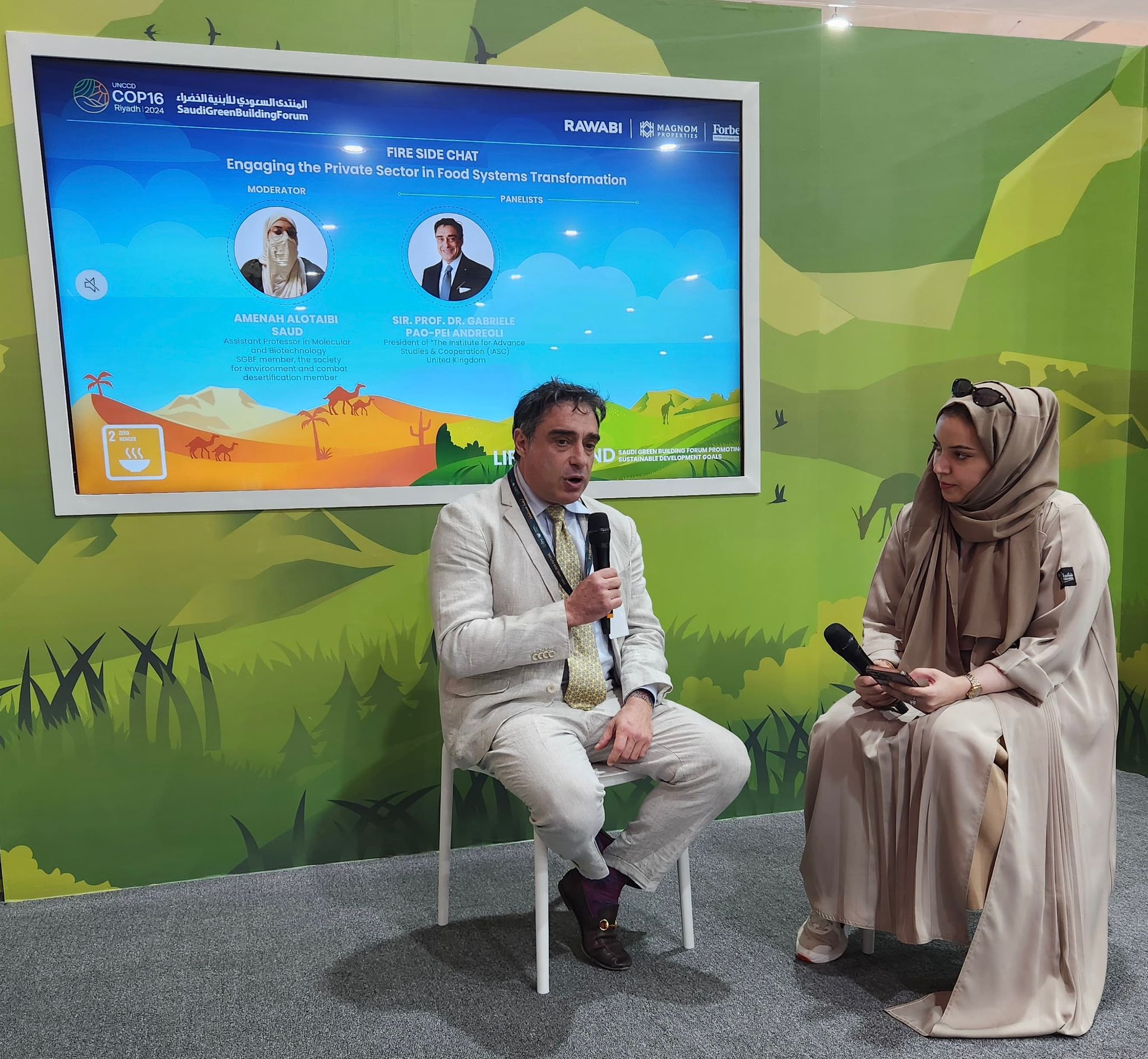
Engaging the Private Sector in Food Systems Transformation: Insights from Sir Prof. Andreoli, President of IASC
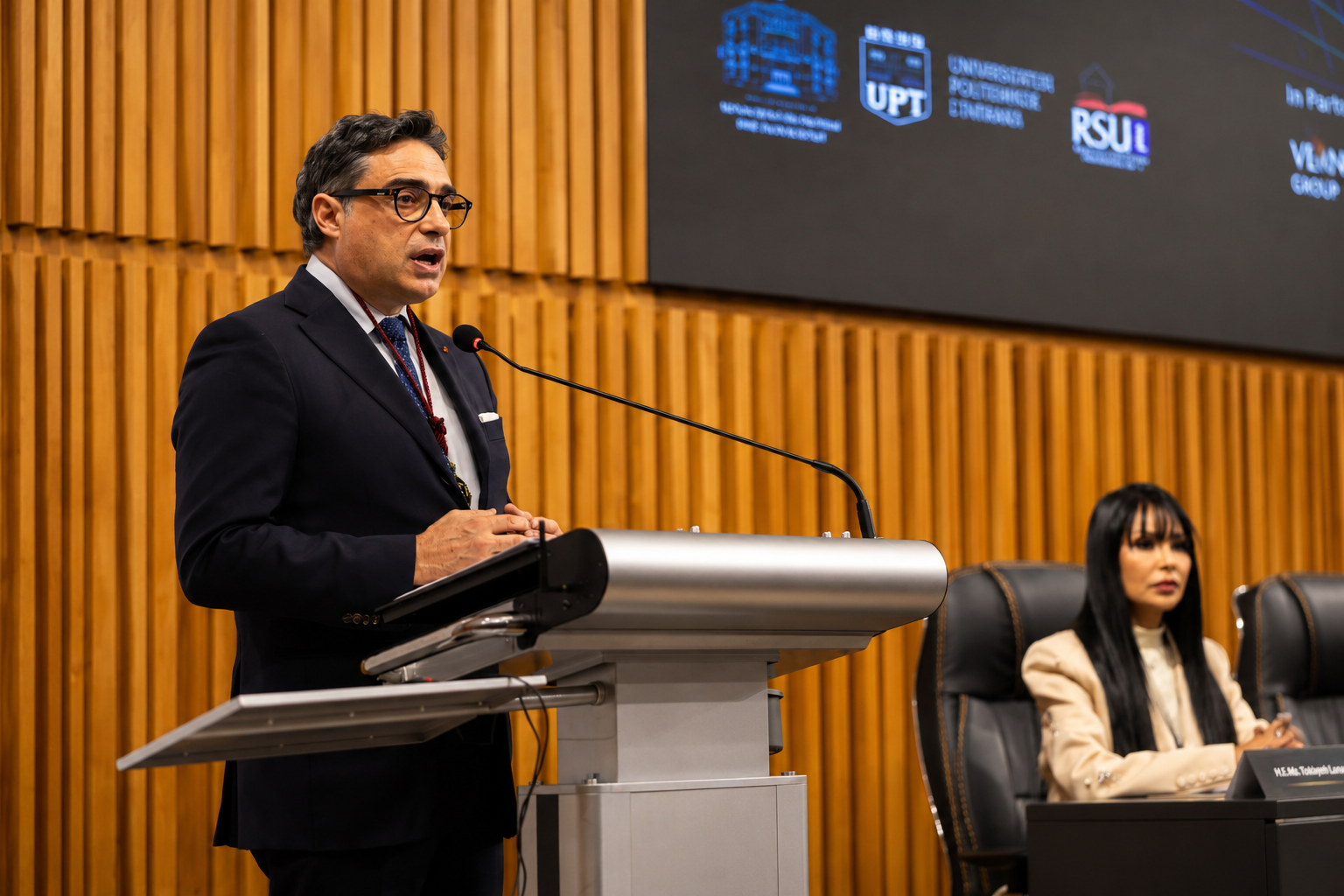
At COP16 in Riyadh, during a panel discussion held at the Green House Pavilion in the Blue Zone titled “Engaging the Private Sector in Food Systems Transformation,” Sir Prof. Andreoli, President of the Institute for Advanced Studies and Cooperation (IASC), was posed a pivotal question:
“How can the private sector be incentivized to invest in sustainable agricultural practices that benefit both the environment and local communities?”
Sir Prof. Andreoli emphasized that one of IASC’s top priorities is fostering collaboration among governments, institutions, universities, associations, visionary leaders, and changemakers. The goal, he explained, is to bring all the pieces of the puzzle together to address global challenges effectively. To illustrate the potential of such collaboration, he highlighted an innovative project supported by IASC: Plant Blue, an initiative led by entrepreneur and visionary Karl Nagy.
This project exemplifies how private entities can adopt ethical business models with social goals, creating shared benefits for local communities and generating revenue. According to Sir Prof. Andreoli, the success of such initiatives depends on close cooperation with local governments and communities, making it a replicable and scalable model for sustainable development.
Tackling an Environmental Threat: The Water Hyacinth
Sir Prof. Andreoli shared the example of Pontederia crassipes (formerly known as Eichhornia crassipes), commonly called the water hyacinth. This aquatic plant, though visually appealing, has become an invasive species outside its natural habitat. It thrives in polluted water bodies, fueled by unfiltered wastewater and chemical fertilizers, spreading rapidly and causing severe ecological damage.
In regions like Lake Victoria, the world’s second-largest freshwater lake and Africa’s largest, the water hyacinth has disrupted ecosystems, choked waterways, and threatened livelihoods. Sir Prof. Andreoli explained that this invasive species poses a dual threat to nature and human well-being, but also represents a unique opportunity.
Turning a Problem into a Solution
The Plant Blue project, supported by IASC, seeks to transform the water hyacinth from an environmental menace into a valuable resource. By harvesting and processing the plant, the initiative restores balance to ecosystems like Lake Victoria, initiating a chain reaction of recovery that benefits wildlife and local economies across Kenya, Tanzania, Uganda, Rwanda, Burundi, and beyond.
Sir Prof. Andreoli highlighted how the project converts water hyacinths into renewable energy, organic fertilizer, and biogas for cooking. It also produces potable water for communities, generates carbon credits to combat climate change, and creates jobs that empower local and regional economies.
“This is a holistic, sustainable system,” Sir Prof. Andreoli explained, “one that enhances the quality of life, restores ecosystems, and offers significant economic returns.”
A Visionary Collaboration
Sir Prof. Andreoli underscored that Plant Blue is a shining example of how ethical models can bring the private sector, governments, and communities together to address complex challenges. Projects like these, he argued, incentivize private enterprises by demonstrating the tangible benefits of investing in sustainable practices.
As President of IASC, Sir Prof. Andreoli reaffirmed the organization’s commitment to fostering partnerships that align ethical values with innovative solutions. Through initiatives like Plant Blue, IASC is proving that sustainable development is not only achievable but also profitable, scalable, and transformative.
“This is how we engage the private sector,” Sir Prof. Andreoli concluded, “as a powerful ally in building a sustainable future for both people and the planet.”
Thanks To

