

















Longevity for Humanity: Regenerative Protocols for Post-Traumatic Recovery and Humanitarian Response
By:
Prof. Gabriele Pao-Pei Andreoli MD
President, Institute for Advanced Studies and Cooperation (IASC)
In collaboration with Daniela Nuti Ignatiuk (DNA22)
Introduction
In the aftermath of war, disaster, and mass trauma, human suffering often lingers long after the emergency fades from the news cycle. At the IASC Longevity Lab, we believe that scientific innovation must serve as a bridge between healing and human dignity, especially for those affected by extreme stress and calamity.
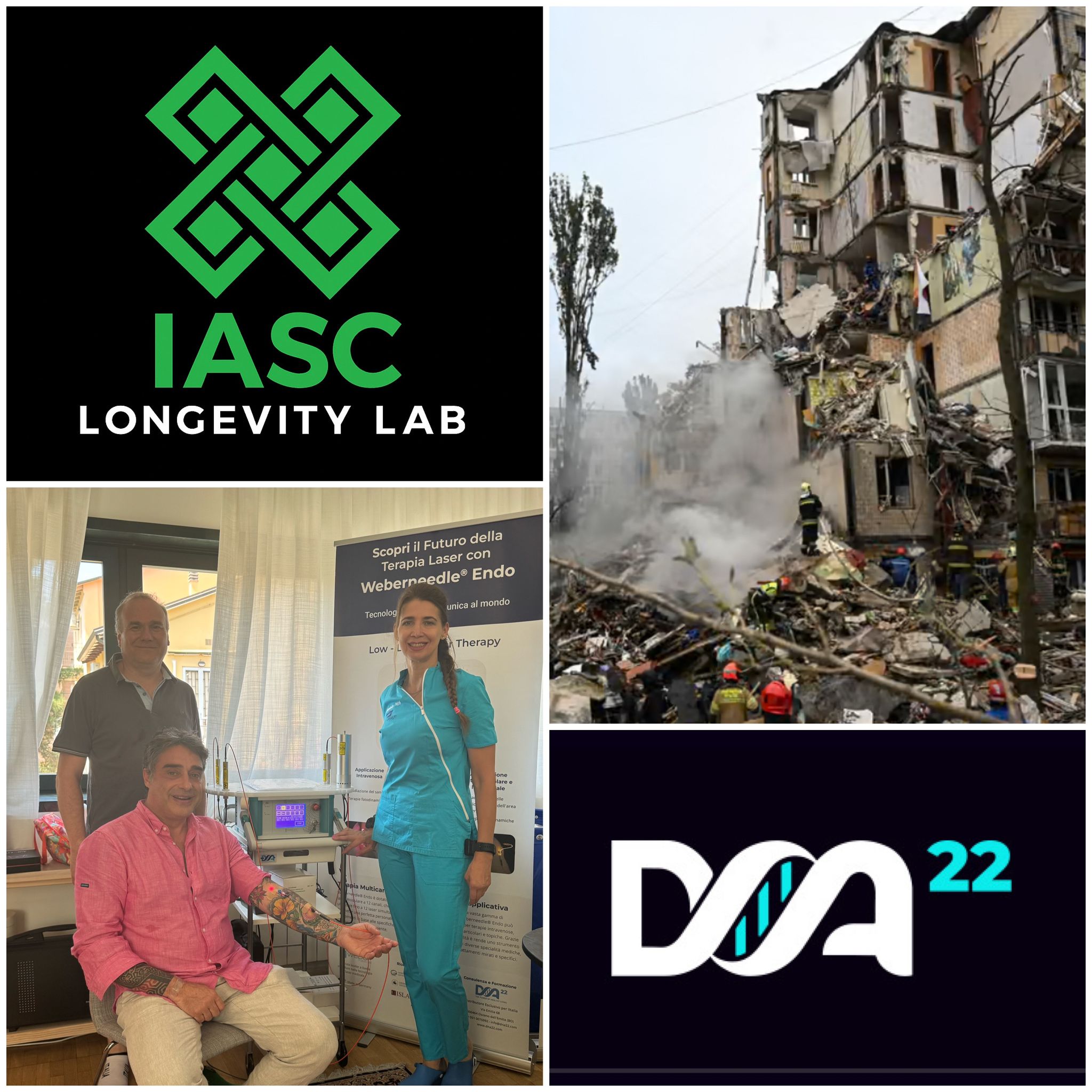
Through a unique partnership with DNA22 and under the leadership of IASC Longevity Lab Director of Strategic Technologies and Innovation, Daniela Nuti Ignatiuk, we are developing and refining regenerative protocols that can be rapidly deployed to support both survivors and first responders. Drawing on previous collaborations with the Red Cross and other humanitarian institutions, our work represents a new frontier: where longevity science meets field resilience.
Scientific Foundations of Post-Traumatic Regeneration
Post-traumatic syndromes are not only psychological; they are systemic. Exposure to acute or prolonged stress alters brain chemistry, suppresses immunity, accelerates cellular aging, and can impair long-term resilience.
The IASC Longevity Lab has thus developed an integrated, bio-scientific framework aimed at regenerating the body from the inside out. Our protocols include:
• Cellular and mitochondrial revitalization, including NAD+ precursors, IV nutrition, and photobiomodulation
• Neuroregeneration and neuroplasticity stimulation, employing PEMF, neurofeedback, and microstimulation
• Stress-axis rebalancing using adaptogenic compounds, vagal stimulation techniques, and sleep optimization
• AI-personalized intervention protocols, based on biometric and genomic inputs
• DNA repair and epigenetic recalibration, particularly in populations exposed to prolonged trauma
These strategies are informed by the latest in molecular biology, regenerative medicine, and integrative neuroscience. They are validated by international experts and developed with the support of DNA22’s cutting-edge technologies in biomarker analysis and non-invasive diagnostics.
IASC’s Vision: Regeneration as Rescue
A central mission of the IASC Longevity Lab is to ensure that these regenerative technologies do not remain confined to elite clinics, but are made immediately available to humanitarian and rescue operations.
We believe that first responders—paramedics, humanitarian workers, firefighters, and volunteers—deserve the same regenerative attention as the lives they save. Their physical and psychological resilience is critical to every emergency response.
To this end, we are building specialized “Rescue Response Protocols” designed for rapid field deployment. These include:
• Portable kits for inflammation control and cognitive recovery
• Non-invasive tools for cellular oxygenation and pain reduction
• Wearable biosensors for real-time stress monitoring
• Field-ready IV and NAD+ protocols for rapid recuperation
• AI-integrated triage support for stress and trauma scoring
Our modular “Flourishing Capsules”, developed by IASC and DNA22, will soon provide mobile units capable of delivering full-spectrum regenerative care in disaster zones—from refugee camps to military operations to climate-induced crises.
Scientific Diplomacy and Global Ethics
Our work stands at the crossroads of innovation and conscience. With deep gratitude for past humanitarian efforts alongside the Red Cross, and inspired by new strategic partnerships across Europe, Africa, and the Middle East, we see longevity science not merely as a commercial sector—but as a moral imperative. Through our research, protocols, and deployment strategies, we reaffirm IASC’s commitment: to heal the invisible wounds of trauma and to protect the protectors. This humanitarian dimension of longevity must become a pillar of every ethical scientific agenda.
Regenerative Mandate
The crises of today—whether geopolitical, environmental, or societal—require more than emergency relief. They demand regenerative recovery. At the IASC Longevity Lab, together with our scientific partners like DNA22 and Daniela Nuti Ignatiuk, we are working relentlessly to make high-impact, fast-responding protocols a reality.
Longevity, in this context, is not just about living longer. It is about recovering fully.
It is about restoring vitality—so that those who serve and those who survive may flourish again.
Thanks To

