


























Digital Sovereignty, Cyber Conflict, and the Future of Secure Digital Architectures
Why resilience, cooperation, and post-quantum security are becoming strategic priorities. The geopolitical landscape of the twenty-first century is undergoing a profound transformation. While traditional military capabilities and economic strength remain important elements of international relations, a new and increasingly decisive dimension has emerged: the digital domain. Today, the infrastructures that sustain modern societies—cloud platforms, data centers, artificial intelligence systems, and communication networks—have become strategic assets. These digital architectures underpin financial systems, healthcare networks, energy grids, transportation infrastructure, and the functioning of public institutions. When these systems operate securely, they enable economic growth, innovation, and societal stability. When they are vulnerable, the consequences can extend far beyond the digital realm, affecting economies, governance, and public trust.
Recent developments in global cyber activity illustrate how digital systems have become an increasingly important arena of geopolitical competition. Cyber operations, disinformation campaigns, and technological disruptions are often integrated into broader strategic dynamics, reflecting the growing importance of hybrid forms of conflict in the contemporary world. The Strategic Importance of Digital Sovereignty. In this evolving environment, the concept of digital sovereignty has become central to discussions among governments, institutions, and technology leaders.
Digital sovereignty refers to the ability of nations and institutions to maintain meaningful control over the digital infrastructures and technological ecosystems upon which their societies depend. This includes the governance of data, the security of communication networks, the resilience of cloud systems, and the protection of critical digital infrastructure.
For Europe, this challenge is particularly significant. While the continent possesses world-class research institutions, strong regulatory frameworks, and advanced technological capabilities, many of the digital infrastructures used across Europe remain dependent on technological ecosystems based outside the European Union. Ensuring greater resilience and autonomy in digital infrastructure therefore represents a strategic priority for the coming decades.
European Initiatives and the Role of Italy. Recognizing these challenges, the European Union has begun to develop initiatives aimed at strengthening technological autonomy and the resilience of digital infrastructures.
One important development in this direction is the European Digital Infrastructure Consortium (EDIC), an initiative designed to support the development of secure and interoperable digital infrastructures across the European Union.
Within this framework, Italy is playing an increasingly important role. Serafino Sorrenti, head of the technical secretariat of the Italian Department for Digital Transformation, has recently been appointed Executive Vice President of the EDIC consortium.
This appointment reflects the growing importance of coordinated European efforts to develop sovereign digital infrastructures capable of supporting cybersecurity, data governance, and technological resilience.
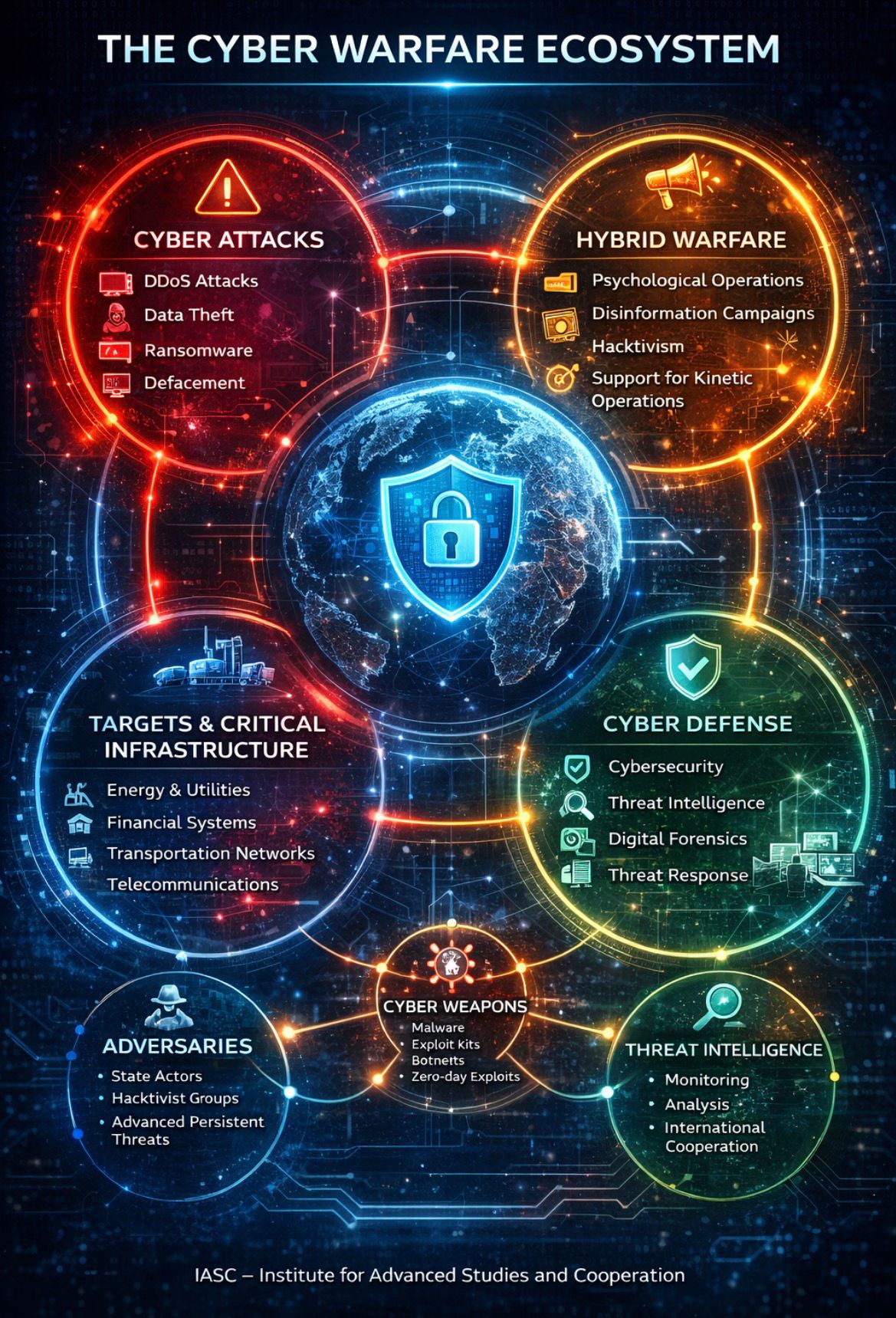
Understanding the Cyber Warfare Ecosystem
Modern cyber conflict operates through a complex ecosystem involving multiple actors and strategies. State-aligned cyber units, hacktivist groups, and advanced persistent threat actors increasingly engage in activities such as digital reconnaissance, distributed denial-of-service attacks, data theft, ransomware operations, and digital sabotage. At the same time, information operations and misinformation campaigns have become central tools in hybrid strategies, aiming to influence public perception and create instability in targeted societies. These dynamics highlight the convergence between cybersecurity, information warfare, and geopolitical competition. Protecting digital infrastructures therefore requires not only technological defenses but also interdisciplinary collaboration among experts in cybersecurity, digital forensics, governance, and strategic policy.
The Role of the Institute for Advanced Studies and Cooperation
The Institute for Advanced Studies and Cooperation (IASC) is dedicated to advancing interdisciplinary research and international dialogue on emerging technological challenges. Working at the intersection of technology, governance, and global cooperation, the Institute promotes initiatives addressing cybersecurity and cyber resilience, digital sovereignty and technological governance, artificial intelligence and emerging technologies, strategic digital infrastructure, and hybrid conflict dynamics in the digital age.
Through its international network of researchers, policy experts, and technology professionals, the Institute contributes to discussions on how emerging technologies can be governed responsibly while strengthening societal resilience.
Among the professionals contributing to the Institute’s initiatives is Selene Giupponi, whose expertise in digital forensics and cyber investigation methodologies supports the Institute’s interdisciplinary work on cybersecurity and digital resilience.
In addition, several members of the Institute’s network are actively engaged in professional work related to cybersecurity, threat intelligence, and digital risk analysis, strengthening the Institute’s contribution to discussions on technological security and resilience.
Post-Quantum Security and the Future of Cyber Defense As digital technologies continue to evolve, the next frontier of cybersecurity is already emerging: post-quantum security.
Quantum computing has the potential to transform computational capabilities, but it also poses a challenge to many of the cryptographic systems currently used to secure digital communications and infrastructure.
Preparing for this transition will require the development of quantum-resilient encryption systems and new cybersecurity frameworks capable of protecting data and critical infrastructures in the coming decades.
In this context, the Institute for Advanced Studies and Cooperation is actively promoting international dialogue on the strategic implications of quantum technologies.
These issues will be addressed at the Balkan Quantum Initiative Summit, scheduled for 24 April in Tirana, Albania, where policymakers, researchers, and technology leaders will explore the role of quantum technologies in cybersecurity, digital sovereignty, and the protection of critical infrastructures.
The initiative aims to foster collaboration across Europe and beyond in the development of secure and resilient digital architectures for the quantum era.
A Strategic Responsibility for the Digital Age
The rapid evolution of cyber threats and hybrid conflict dynamics demonstrates that cybersecurity is no longer simply a technical challenge.
It has become a strategic priority affecting national security, economic stability, and the resilience of democratic institutions.
Just as previous generations invested in energy networks, transportation systems, and telecommunications infrastructure, today’s leaders must invest in secure digital architectures capable of sustaining societies in an increasingly complex technological environment.
Digital sovereignty is therefore not merely a technological ambition. It is a shared responsibility for safeguarding the stability and resilience of our interconnected world.
Prof. Sir Dr. Gabriele Pao-Pei Andreoli
President
Institute for Advanced Studies and Cooperation (IASC)
Thanks To

