






















Fadil Berisha IASC World Changers Ambassador: The Ethics and Art of Inspiring Generations
Spending a day in the New York studio of Fadil Berisha – iconic Albanian-American photographer, born in Kosovo and raised between Europe and the United States – means entering a space where light, memory and human dignity are patiently sculpted into images. The studio is intimate and cosmopolitan at once: portraits that watch you back, objects that tell stories, and a quiet seriousness behind each frame.
I was there as President of the Institute for Advanced Studies and Cooperation (IASC), but even more as a scholar and friend. The aim was not a ceremonial visit, but a true intellectual and human encounter – to listen, to understand the deeper trajectory of his work, and to outline a path of future collaboration. Our conversation naturally turned to the responsibility of inspiring the young generation, the social role of images, and his new role as IASC World Changers Ambassador of Creativity, Dignity and Social Change.
What emerged is the profile of an artist who has already left a profound mark on contemporary visual culture and who consciously uses his talent to elevate the human spirit, promote inclusivity and offer direction to those who will inhabit the future.
Berisha’s biography is marked by crossings: from Kosovo to Europe, from Europe to New York, from the periphery of global narratives to their very centre. This multiplicity of roots is not secondary; it informs his gaze. In his work, a refined European sense of proportion and classical beauty meets the diversity, energy and contradictions of American culture. Over the years, he has become an internationally recognised figure in fashion and portrait photography, collaborating with leading brands and institutions and serving for many years as official photographer for Miss Universe and Miss USA. His campaigns for global luxury houses and his portraits of actors, musicians, athletes and public figures are widely known. Yet, beyond the prestige of names and logos, what distinguishes Berisha is the ethical direction of his practice. For him, photography is never a simple exercise in aesthetics. Each image is conceived as a narrative: not only the representation of a face, but the reflection of a life trajectory, a cultural identity, a personal struggle or aspiration. The lens does not dominate; it encounters.
Looking closely at his work, one immediately notices a tension – never resolved, always fruitful – between glamour and introspection. Technically, the images are impeccable: carefully controlled light, sculpted shadows, precise chromatic balance, a compositional discipline that speaks of years of study and experience. But beyond technique, there is something more essential. Actresses, models, artists and public figures appear with great elegance, yet never reduced to consumable icons. A look that questions, a gesture that reveals vulnerability, a posture that suggests character and history: these details restore depth to faces often flattened by media dynamics. In a world where images frequently objectify, standardise and accelerate consumption, Berisha chooses another route. His search for aesthetic perfection is at the service of a higher aim: the recognition of the irreducible dignity of each person, the celebration of individuality, the affirmation that every story deserves respect.
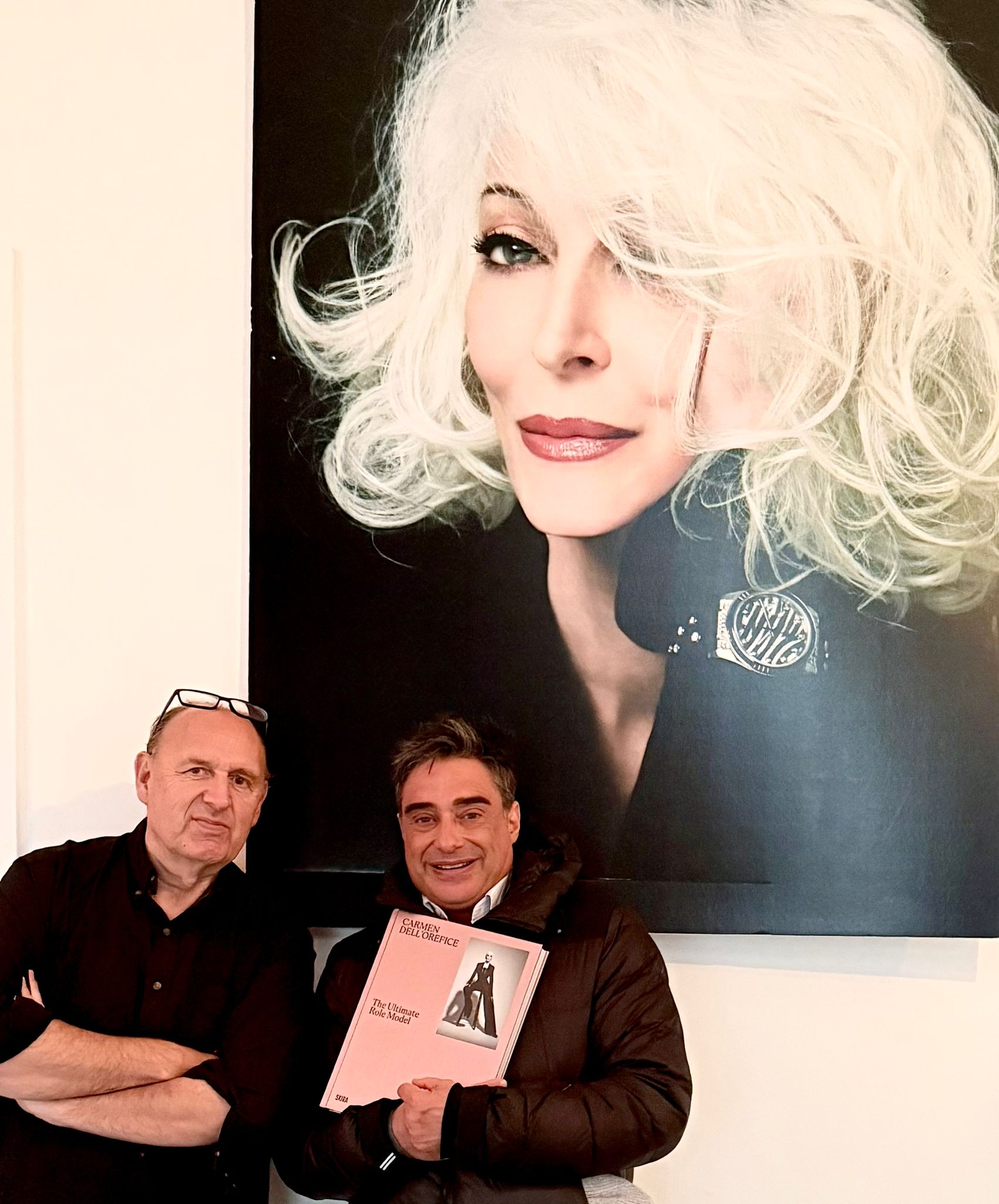
This is precisely where his work resonates with the mission of IASC World Changers. Our initiatives in scientific diplomacy, ethics, education and innovation place the human person at the centre. In his own field, Berisha does the same: beauty becomes a positive medium of evolution, creation and inclusivity. A key chapter in his oeuvre is the long collaboration with the legendary supermodel Carmen Dell’Orefice. Her exceptional career – from teenage model to style icon in her nineties The volume Carmen Dell’Orefice: The Ultimate Role Model brings together decades of shared work and offers more than a collection of beautiful photographs; it functions as a visual manifesto. In these portraits, especially those from Carmen’s mature years, age is not hidden or corrected. The lines of the face, the intensity of the gaze, the elegance of gesture become signs of inner architecture, of a life inhabited and not merely traversed. This is an ethical choice. It affirms that dignity and charisma can grow with time, that beauty has many seasons, and that the visual and fashion industries carry responsibility for how age, femininity and identity are represented. For the younger generation, these images offer a counter-narrative to the culture of instant perfection: they speak of perseverance, discipline, fidelity to one’s vocation. For IASC World Changers, this work is also a pedagogical instrument. It allows us to discuss with young people not only aesthetics, but flourishing, professionalism, and the courage to inhabit one’s own. One of the most significant moments in our exchange concerned the condition of today’s youth. Young people live immersed in an uninterrupted flow of images; they “see” everything, yet are rarely helped to interpret what they see. Berisha is acutely aware that images can disorient or orient, trivialise or elevate, isolate or connect. For this reason, he understands photography as a social responsibility. Choosing what to show, how to frame, whom to give visibility to – these are moral decisions. His long-standing engagement with his own community and with emerging talents shows a consistent intention: to use visibility not as self-promotion, but as a platform to support others. Here again, our visions converge. IASC World Changers is committed to building educational pathways in which art, ethics and technology reinforce one another. Together with Berisha, we intend to develop:
• Educational visual content for schools and universities, centred on identity, diversity, intergenerational dialogue and ethical representation.
• Workshops and masterclasses that combine technical training with reflection on responsibility, respect and inclusion in visual culture.
• Interdisciplinary projects in which photography enters into dialogue with artificial intelligence, neuroscience, diplomacy and social innovation, offering young people new tools for understanding and acting in the world.
As IASC World Changers Ambassador of Creativity, Dignity and Social Change, Berisha is not simply an emblematic figure; he is a partner in a long-term project. His work shows that photography, when practised with integrity, can become service to persons, communities and future generations.
In an era saturated with images, the true measure of a photograph is not only how it looks, but what it awakens – in our conscience, in our imagination, and in our shared responsibility for a more humane world.
Thanks To

