



















From Sustainability to Flourishing: IASC Presents a Constitutional Vision for Peace at the Vatican
Vatican City — In recent years, the Institute for Advanced Studies and Cooperation (IASC) and IASC World Changers have advanced a structured journey of reflection and high-level dialogue on the ethical governance of emerging technologies—artificial intelligence, transparent digital architectures, and quantum technologies—in service of peace and human flourishing.
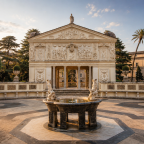
This journey was initiated within Vatican City, through encounters and interdisciplinary work convened at Casina Pio IV, where IASC World Changers fostered a unique space of convergence between science, law, spiritual leadership, and responsible innovation. The guiding question has remained consistent: can technological power be constitutionally governed so that it protects human dignity, limits domination, prevents systemic violence, and supports a cooperative global order?
A Meeting at the Secretariat of State
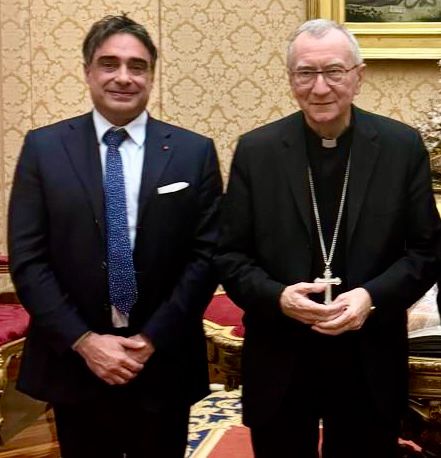
Yesterday morning, in a moment of particular significance, Sir Prof. Dr. Gabriele Pao-Pei Andreoli, President of IASC and Founder of World Changers, was received at the Secretariat of State of the Holy See for a substantive discussion on future peace-oriented initiatives. The meeting took place on the birthday of Cardinal Pietro Parolin, Secretary of State, and focused on the urgent need to strengthen global pathways to peace amidst the current international climate of conflict, fragmentation, and widespread human suffering.
During the meeting, Professor Andreoli formally presented a letter requesting Cardinal Parolin’s moral guidance for a proposed international initiative: the advancement of a world federal garantist constitutionalism for peace, designed to be endorsed by leaders and institutions globally, and progressively translated into practical legal and technological architecture.
At the same time, Professor Andreoli offered Cardinal Parolin a copy of his forthcoming book:
World Federal Constitutionalism and Power Technologies in the Quantum Age
An Ethical-Garantist Compendium for World Peace
co-authored with Alberto Contu and structured upon the constitutional and garantist framework developed by Professor Luigi Ferrajoli. The volume proposes a systematic reflection on how emerging technological infrastructures can be constitutionally bound—so that they do not become instruments of domination, but safeguards of rights, justice, and peace. 
Toward Global Signatures and Practical Architecture
A key objective of the initiative is to launch a voluntary and gradual process of international adherence, through which heads of state, governments, and global institutions may subscribe shared constitutional principles of peace—not as a symbolic declaration, but as a commitment to begin building the corresponding operational structures.
The proposed roadmap envisions:
• an initial nucleus of states and institutions endorsing common peace-oriented constitutional principles;
• a practical phase of design and verification of ethically governed technological infrastructures supporting those principles;
• and an enlarging process of international participation aimed at shaping a more just and cooperative global order.
The Blessing of the Holy Father
At the heart of the meeting was a request expressed with humility and conviction: that this path may be discerned and morally accompanied under the authority of the Holy See, and—if deemed appropriate—receive the blessing of the Holy Father, as a prophetic sign capable of inspiring leaders and peoples toward a shared horizon of peace.
IASC considers this spiritual and moral dimension essential: technology must not replace human conscience, but serve it. The constitutional project is therefore grounded in the dignity of the human person, responsibility, and the belief that innovation—when guided by ethical clarity—can help humanity move beyond the logic of militarisation toward a civilisation of cooperation and flourishing.
A Convergence with the Holy See’s Diplomatic Vision
Significantly, shortly after the meeting, Cardinal Parolin delivered a public address on the current global condition, describing a world order that appears increasingly disoriented and reaffirming the Holy See’s commitment to continue weaving pathways of peace through dialogue, justice, and the primacy of the human person.
For IASC, this convergence between the Holy See’s diplomatic vision and the constitutional and technological framework proposed by the Institute represents an important moment of alignment—one that strengthens the resolve to proceed with a concrete, internationally oriented process.
IASC Commitment
IASC and IASC World Changers reaffirm their commitment to advancing an ethically governed future in which peace is not only a moral aspiration, but a constitutional, institutional, and technologically supported reality—capable of generating greater human and economic value than war, and opening a new era beyond sustainability: the age of flourishing.
Thanks To

