


















IASC and Dario Maximilian Spera: A Groundbreaking Collaboration for the Future of Medicine and Technology
IASC and Dario Maximilian Spera: A Groundbreaking Collaboration for the Future of Medicine and Technology
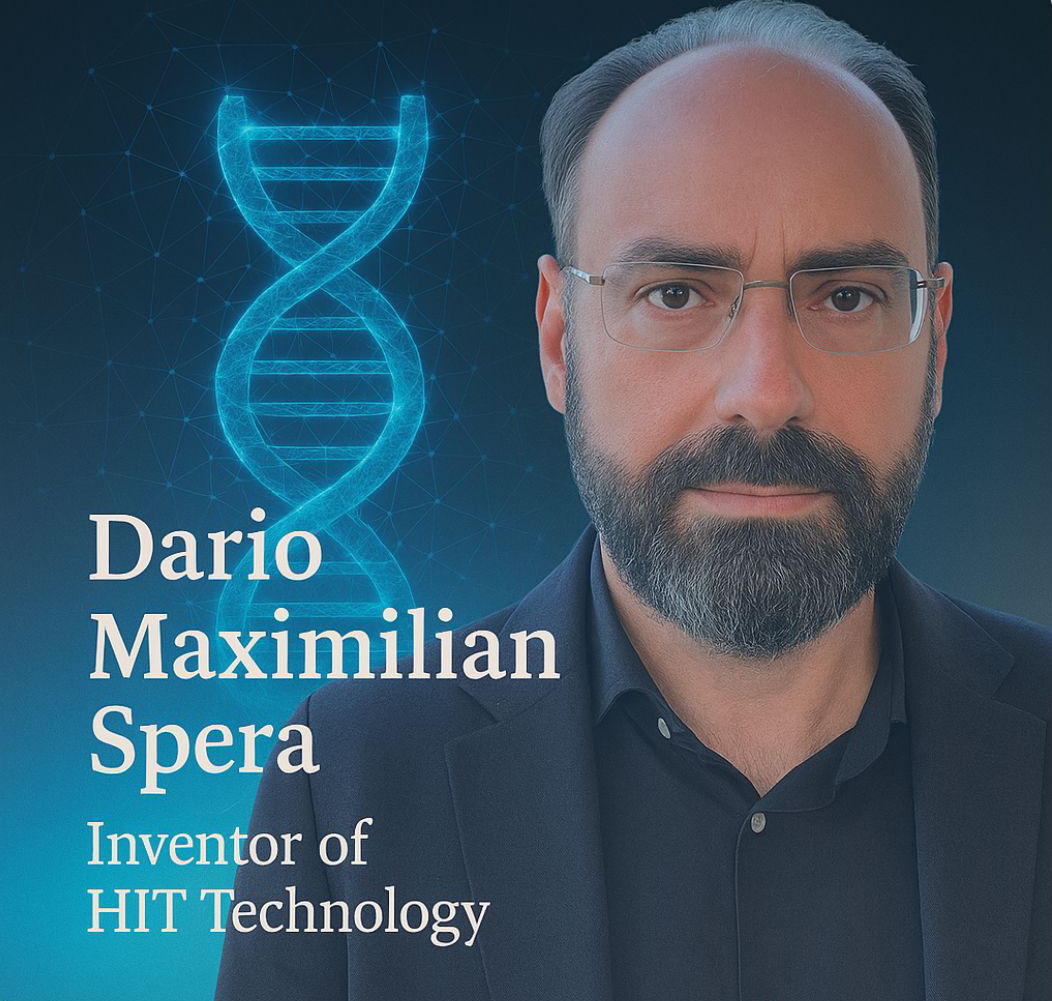
For years, the Institute for Advanced Studies and Cooperation (IASC) has proudly collaborated with researcher and inventor Dario Maximilian Spera, the brilliant mind behind the Holographic Information Transfer (HIT) technology. This revolutionary innovation is finding extraordinary applications and receiving exciting confirmations that promise to transform the field of medicine and beyond.
But what exactly is HIT?
Holographic Information Transfer (HIT) is based on the principle that in a hologram, each part of the information contains the entirety of the original data. The technology captures the faint electromagnetic activity of biologically active molecules—such as active ingredients of drugs or endogenous molecules like prostaglandins or cytokines—and uses it to induce a stabilized spatial orientation of electric charges, coherent with the electromagnetic activity of the molecule of interest.
When excited or powering a device, these charges become new vectors carrying the biological and metabolic effects of the initial molecule, without the need for its chemical component. Moreover, HIT technology can selectively oxidize or reduce specific molecules, modifying their chemical structure and thereby activating or inhibiting their biological activity.
The foundations of HIT lie in applied quantum physics, supported by the ongoing advancements in nanotechnology and innovative materials such as carbon nanotubes, graphene, quantum dots, and upconverting nanocrystals.
In the medical field, HIT technology enables non-invasive, innovative treatment approaches for a wide variety of health conditions. It has demonstrated capabilities to induce anti-inflammatory, antioxidant, analgesic, anti-edema, bacteriostatic, virostatic effects, as well as tissue regeneration and immunomodulation—offering a broad spectrum of therapeutic applications.
HIT also finds application in industrial sectors, significantly increasing productivity yields, notably in agriculture and horticulture, while supporting sustainability through enhanced product shelf life.
Thanks to collaboration with universities and public and private research institutes, HIT has received CE Medical Certification for several devices, some of which are already available on national and international markets.
One notable example is a HIT device developed in partnership with a consortium including the University of Sassari, Tor Vergata University, La Sapienza University of Rome, and the Institute of Sports Medicine of Rome. Clinical studies demonstrated its ability to enhance proprioception, leading to its adoption by Italian Olympic athletes and several national sports federations.
Another remarkable HIT application includes a patch that optimizes ionic and proton exchange, improving blood oxygen saturation, lowering heart rates, and reducing lactic acid production—currently used by the Italian Triathlon Federation and various national soccer and basketball teams.
Further innovations in ophthalmology have led to the development of Medical Class 1 devices supporting glaucoma and maculopathy treatments. Moreover, after three years of collaboration with the University of Cagliari, HIT has launched devices targeting maxillofacial fibromyalgia and neuropathic maxillofacial pain.
An impressive comparative study highlighted HIT’s antioxidant capabilities against traditional chemical supplements like Ascorbic Acid, Glutathione, and Ubiquinol, demonstrating superior in vitro and in vivo results simply through smartphone electromagnetic radiation.
HIT has also forged a strong partnership with Bambino Gesù Pediatric Hospital in Rome, producing significant experimental evidence, such as the ability to delocalize heavy metal ions from cells, facilitating cellular detoxification.
A particularly groundbreaking achievement is the development of the Anti-Malaria Medical Class 1 Device, showing 100% clinical success in early trials conducted in major hospitals in Nigeria and Cameroon. This two-element device—a bracelet and a liver-area patch—uses quantum nanocrystal-generated electromagnetic signals to create an inhospitable environment for the Plasmodium parasite, without pharmacological intervention. Further clinical trials are currently being organized in Ivory Coast, Rwanda, and Kenya, with great optimism regarding continued success.
Building on these achievements, HIT is expanding its applications to areas such as Graft Versus Host Disease (GVHD), autoimmune diseases, and oncology.
In addition to medical and humanitarian pursuits, through the project HIT Malaria (www.hitmalaria.org), IASC and Dario Maximilian Spera have embarked on new scientific explorations, pushing the boundaries of industrial, recreational, wellness, and medical applications. Among the most promising joint initiatives currently under development are:
• A Crohn’s Disease therapy, aimed at providing a revolutionary non-invasive approach;
• Water informatization to endow water with antioxidant properties, thereby reducing oxidative stress and inflammation;
• Agricultural innovations, including the treatment of plants against parasites and fungi, and the creation of electromagnetic fertilizers to significantly enhance agricultural production.
Thanks to the ability of HIT to modulate specific molecular activities, promoting or inhibiting their expression, the opportunities for highly targeted results in diverse sectors are endless.
The recent integration of Artificial Intelligence (AI) and the imminent incorporation of Quantum Computing into HIT technology are opening extraordinary new frontiers, promising to redefine the paradigms of science, medicine, and sustainability for the years to come.
IASC remains firmly committed to supporting and advancing these visionary collaborations, which embody our mission to foster ethical innovation for the betterment of humanity.
Water informatization to endow water with antioxidant properties, thereby reducing oxidative stress and inflammation;
Thanks To

