



















The 3rd Saudi Forum for the Fourth Industrial Revolution
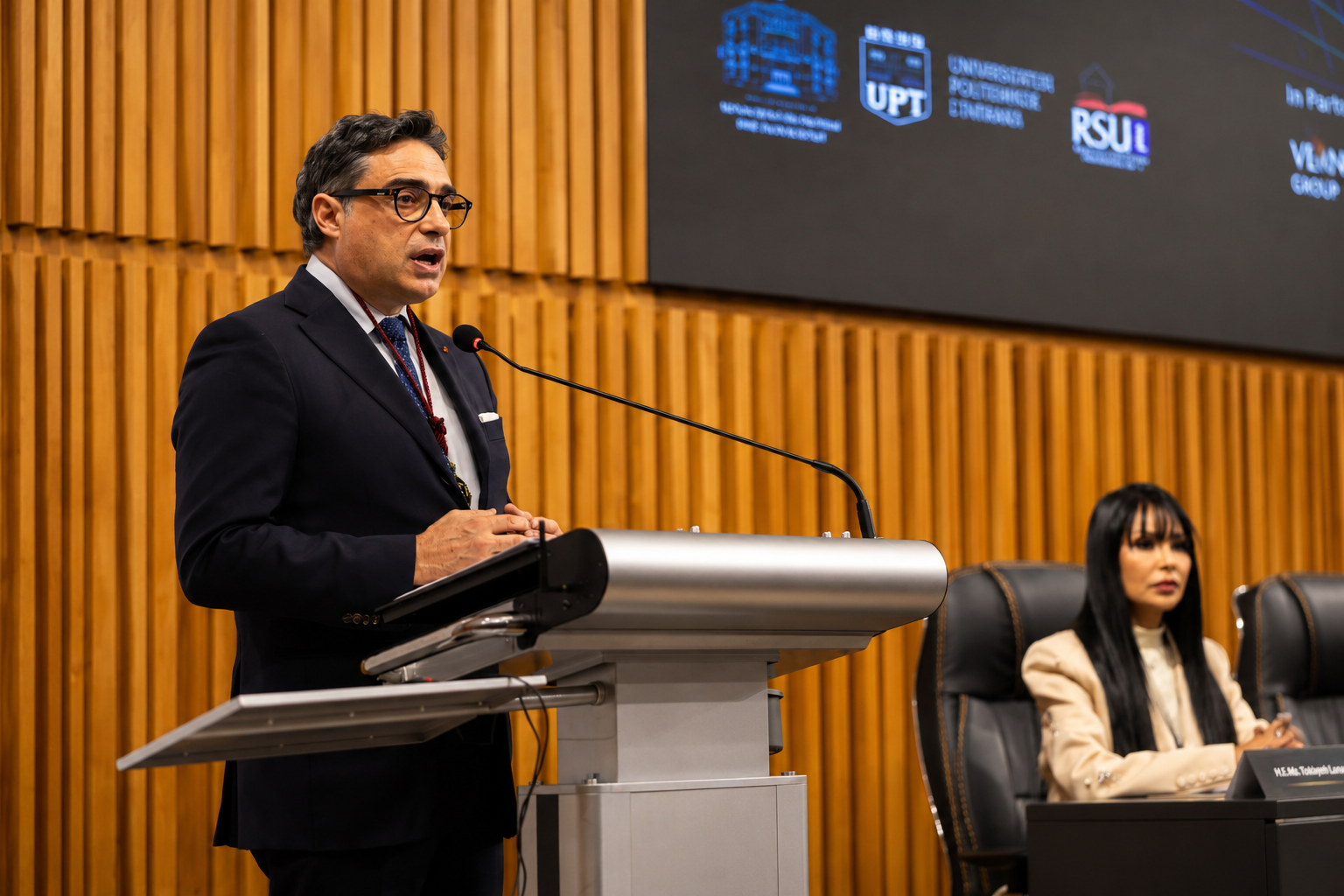
Riyadh, October 2025—The 3rd Saudi Forum for the Fourth Industrial Revolution, Frontiers of Global Technology, offered more than a stage for announcements and projections; it created a space where scientific excellence, policy vision, and ethical reflection could meet as partners rather than competitors. Attending in my dual capacity as President of the Institute for Advanced Studies and Cooperation (IASC) and as Liaison to the Pontifical Academy of Theology in Vatican City, I witnessed how a shared language of responsibility can begin to turn technological capability into a grammar of peace. This was made possible by the gracious leadership of Dr. Basma AlBuhairan, Director of the Center for the Fourth Industrial Revolution (C4IR) Saudi Arabia, whose invitation and hospitality enabled a truly substantive dialogue among stakeholders committed to human-centred innovation. The contemporary technological landscape—spanning artificial intelligence, advanced computation, biotechnology, and data-driven systems—demands more than admiration for novelty. It requires a disciplined ethic of stewardship, a recognition that the measure of progress is not speed or scale alone, but the extent to which new tools protect human dignity, strengthen social cohesion, and widen access to opportunity. In this sense, the Forum in Riyadh was not merely timely; it was exemplary. Conversations moved beyond slogans to address the practical architecture of trust: how to embed transparency and accountability in complex models; how to govern data with integrity across its lifecycle; how to anticipate quantum-era risks to cryptography and infrastructure without paralysing beneficial research and deployment.
IASC’s contribution centred on scientific diplomacy understood as a method of bridge-building: a way of transforming shared technical problems into shared civic purposes. Where political narratives can divide, common epistemic standards—measurement, verification, peer scrutiny—invite collaboration. Where national interests naturally diverge, the prevention of systemic failure in health, energy, finance, and critical services provides a compelling basis for cooperation. In Riyadh, this meant articulating an agenda that links ethical and inclusive AI to the habits of good governance; that connects quantum readiness to public trust; and that treats education not as an afterthought but as the long horizon on which any strategy stands or falls. Technology, after all, is never neutral in its effects; it reflects the virtues and limits of its makers. “Ethics is not a constraint on progress,” I said during the sessions. “It is the compass that makes progress meaningful.”
This compass points first to the person. Systems should be designed to serve, not to substitute, the human; to augment judgement, not to trivialise it. It also points to justice: the gains and the burdens of innovation must be distributed fairly, with deliberate attention to those least served by current arrangements. Finally, it points to responsibility: foresight, continuous monitoring, and the humility to correct course when harms or unintended consequences appear. These principles, deeply resonant with the Vatican’s long-standing reflection on technology and the human person, found a ready echo in C4IR Saudi Arabia’s commitment to aligning innovation with societal benefit. The alignment is not accidental; it reflects a shared conviction that prosperity without purpose is brittle, and purpose without practical implementation is empty.
From this foundation, the conversations in Riyadh turned naturally to institutional craft—how to convert aspiration into practice. Rather than publishing principles that sit untouched on a shelf, participants explored the operational mechanisms that give ethics real traction: impact assessments and audit trails that are proportionate to risk; reproducible evaluation of model behaviour; resilient data provenance; and the disciplined migration to quantum-resilient cryptographic standards. Crucially, these mechanisms gain legitimacy when they are developed across borders and sectors—government, academia, industry, and faith-inspired institutions—so that trust is earned not by assertion but by performance in the open.
Education emerged as the quiet centre of gravity. Building trustworthy systems presupposes a generation of practitioners and leaders fluent in both technical detail and ethical judgement. The Forum highlighted the need for executive programmes that bring engineers and policymakers into a shared seminar room; for research residencies that link laboratories, universities, and public agencies; for fellowships that treat governance as a craft to be learned, refined, and renewed. In our discussions with C4IR Saudi Arabia, we explored pathways for scholar exchanges and joint publications that move seamlessly from principle to playbook, from case study to standard, from pilot to scaled deployment. Such vehicles of exchange do not merely disseminate knowledge; they create the habits of cooperation that sustain peace.
Peace itself—often invoked, less often specified—acquires a concrete profile when framed through scientific diplomacy. It is the practical, measurable reduction of risk in systems upon which all depend. It is the decision to share methods before crises force the sharing of blame. It is the commitment to ensure that the benefits of intelligence, whether artificial or augmented, are not the preserve of the few but the patrimony of the many. Seen this way, the Kingdom’s investment in convening the global community around the Fourth Industrial Revolution constitutes not just a technological bet, but a civic one: that stability and flourishing can be engineered, in part, through institutions designed to cooperate.
The gratitude IASC extends to Dr. Basma AlBuhairan is therefore more than ceremonial. It is an acknowledgement of intellectual leadership exercised with grace: convening diverse perspectives, insisting on substance, and keeping the conversation tethered to impact. Under her direction, C4IR Saudi Arabia provided a forum that was rigorous without being narrow, ambitious without being naïve. As partners, we are encouraged to pursue concrete next steps—policy notes that inform institutional choices, workshops that translate governance frameworks into implementation guides, and colloquia that hold us accountable for results measured not only in citations or prototypes, but in services that become safer, fairer, and more reliable for ordinary people.
The work ahead is difficult by definition, but it is also deeply hopeful. The very disciplines that make science credible—method, transparency, and correction—can make societies more peaceful when they are brought into public life. In Riyadh, that hope took practical form. For IASC, it affirmed a simple proposition: that the future is not something to predict, but something to govern for the sake of human dignity. If we keep ethics as our compass and the common good as our destination, the Fourth Industrial Revolution can be remembered not only for the power it unleashed, but for the bridges it built.
Thanks To

